Twelve Questions. One Decision.
Every autonomous AI action may simultaneously touch identity, delegated authority, regulated data, financial policy, external knowledge, and model behavior. The decision is horizontal. Today our tooling remains vertical.
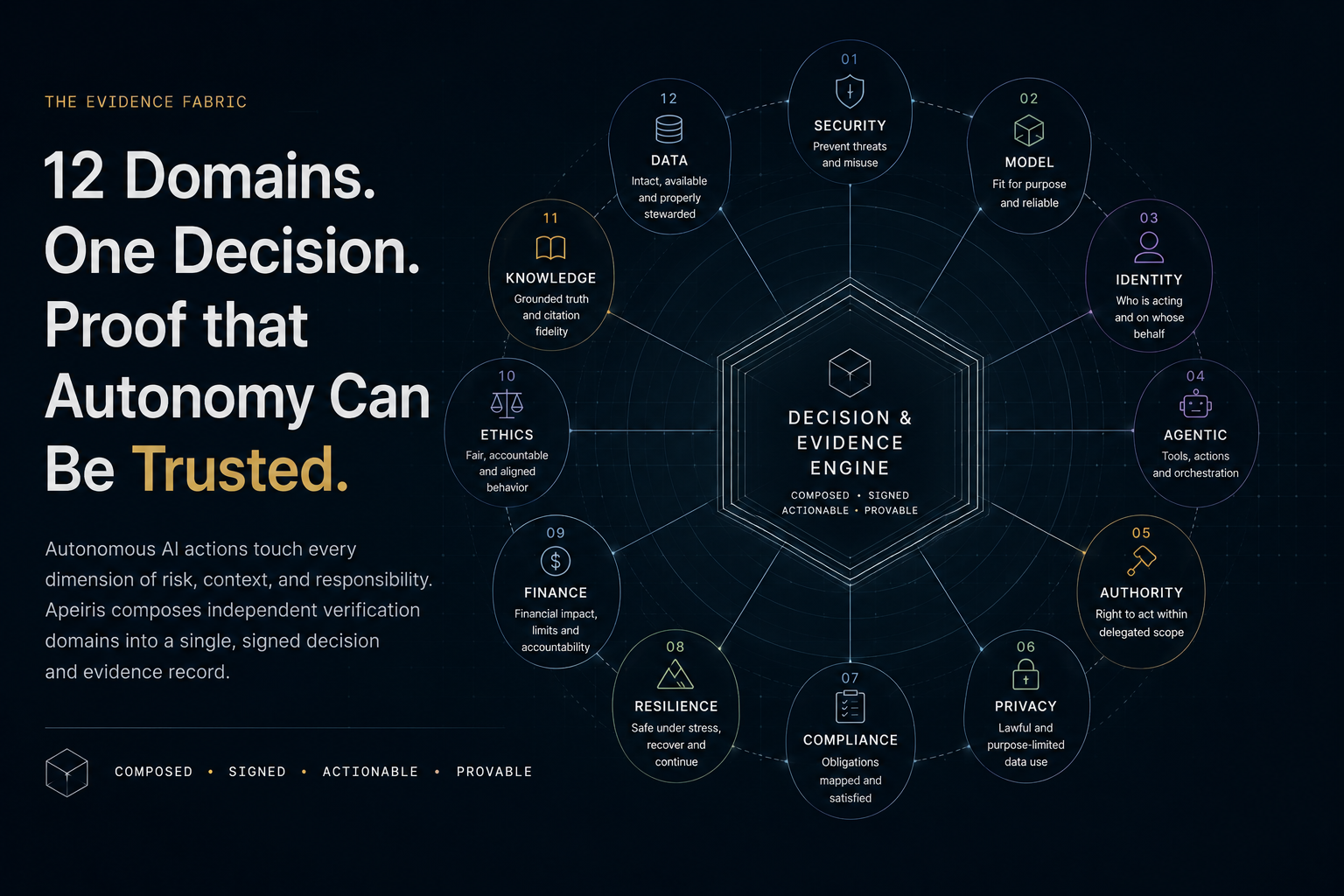
Based on my experience, observations, interactions, and efforts in the real world. This is the basis for my thesis on where this AI thing is going as a simplified mental model.
Every meaningful technology shift eventually changes the architecture around it. The move from physical servers to cloud computing didn't eliminate networking, identity, storage, or security. It reorganized them. The move from monolithic applications to micro-services didn't remove governance. It required new forms of observability, orchestration, and policy.
Autonomous AI is creating another architectural shift. Most of today's conversation focuses on models, agents, or tools. Those are important, but they are only one dimension of the problem.
The harder question is this: How do you prove an autonomous action should have happened?
That answer cannot come from a single security control, a single model evaluation, or a single governance framework. It requires evidence from many independent domains.
Every Domain Answers a Different Question
As we built our first verification domains, one realization became increasingly obvious. Each discipline is solving a fundamentally different verification problem.
Each domain is valuable independently. Each produces evidence. Each reduces uncertainty.
None is sufficient on its own.
The Missing Layer
Today's enterprise tooling largely reflects organizational structure. Security teams buy security platforms. Privacy teams buy privacy platforms. Model risk teams buy model governance platforms. Identity teams deploy identity systems. Each becomes very good at answering its own question.
But autonomous systems do not operate inside organizational silos.
A single AI action may simultaneously touch identity, delegated authority, regulated data, financial policy, external knowledge, internal policy, and model behavior before producing an outcome.
The decision is horizontal. Today our tooling remains vertical. That mismatch becomes more important as autonomy increases.
From Signals to Decisions
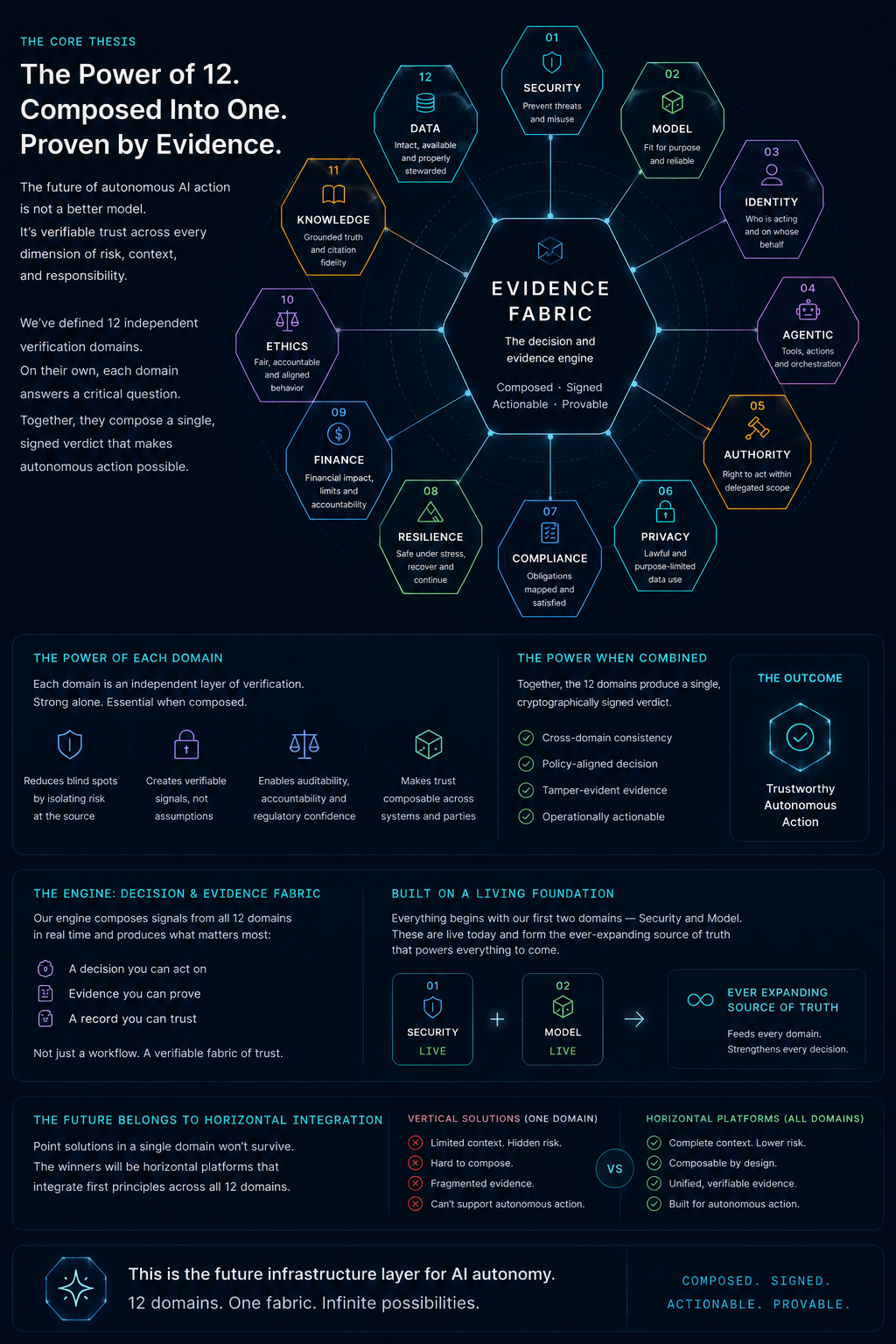
This led us to what has become my central thesis. The future is not a collection of independent verification systems. It is a composable evidence architecture.
Every domain should remain independently owned, independently verifiable, and independently authoritative. Every domain should also produce machine-readable evidence that can be combined with every other domain into a single authorization decision.
The output is no longer simply: "Security passed" or "Privacy passed."
The output becomes: "This autonomous action is supported by composed evidence across every relevant domain, producing a cryptographically verifiable decision that can be audited, reproduced, and trusted."
That is a fundamentally different operating model.
Why I Started with Security and Model
My work did not begin with twelve domains. It began with two. The first was Security. The second was Model Assurance.
Those domains are live today because they solve immediate problems organizations already face. More importantly, they established something larger. They proved that verification domains can be defined using consistent control structures, evidence schemas, machine-readable artifacts, and implementation guidance.
Those living domains are not isolated. They are the beginning of an expanding source of truth. Every new domain inherits the same first principles while extending the overall evidence model. The architecture grows horizontally rather than fragmenting into disconnected systems.
Horizontal Wins
Every major platform shift eventually rewards horizontal infrastructure. Cloud computing produced identity providers, observability platforms, orchestration systems, and service meshes that connected technologies rather than replacing them.
AI autonomy appears to be following the same trajectory.
We expect exceptional products to continue emerging within individual domains. Organizations will continue investing in best-of-breed security, identity, privacy, model governance, financial controls, and compliance technologies. But autonomous enterprises will increasingly need something above those systems.
- A common evidence layer.
- A common decision layer.
- A common trust fabric.
Not because every domain becomes the same, but because every domain becomes a composable layer of information, knowledge, supporting decisions, and outcomes.
Where This Leads
The twelve verification domains are not the destination. They are the vocabulary. The real objective is something much larger. A world where autonomous systems can explain, justify, and prove every significant action they take.
Not through a single model. Not through a single policy engine. Not through a single security product. But through independently verifiable evidence composed across every domain that matters.
That is the architecture we believe autonomous enterprises will ultimately require. And this thesis is only the beginning. All twelve domains are now live: machine-readable, ungated, and openly licensed. The real work begins: validating the evidence model against real autonomous agent deployments, and building the runtime infrastructure that enforces what the vocabulary defines.