Index exposure is not bank contagion
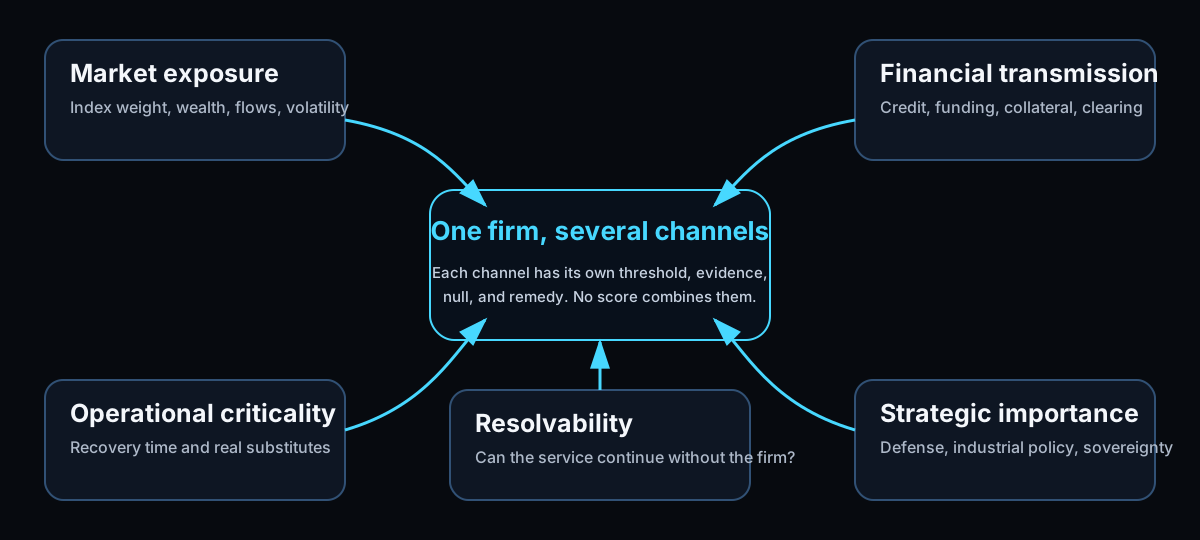
A stock loss becomes financially systemic only when it reaches credit, funding, collateral, clearing, payments, or core intermediaries.
A few very large technology firms may become important to finance, hardware, power, defense, and daily business work at the same time. That does not automatically make them too big to fail. This protocol separates the channels and fixes the evidence needed to test each claim.
The full protocol is published as a chaptered web edition at the full protocol. The frozen PDF is available below.
A stock loss becomes financially systemic only when it reaches credit, funding, collateral, clearing, payments, or core intermediaries.
Stock can fund acquisitions and infrastructure. It creates value only when customers stay, choice remains real, and returns beat the cost of capital.
A deployment can be chip-bound, power-bound, software-bound, or demand-bound. Solving one layer can expose the next.
Custom chips may reduce NVIDIA dependence while increasing cloud dependence. Open weights can reduce model scarcity while shifting rents to infrastructure or applications.
Downloadable weights are not enough. Continuity requires data control, tested failover, skilled operators, security, and an exit path.
Every hypothesis has a trigger, a support rule, an affirmative null, a missing-data rule, and a fixed endpoint. No composite systemic score is used.
| ID | Question | Baseline state |
|---|---|---|
| H1A | issuer shock | Not triggered at baseline |
| H1B | common substrate | Not triggered at baseline |
| H2 | infrastructure finance | Not triggered at baseline |
| H3 | integration | Not triggered at baseline |
| H4 | power-latency | Not triggered at baseline |
| H5 | hyperscaler intermediation | Not triggered at baseline |
| H6 | managed sovereignty | Not triggered at baseline |
| H7 | open-weight rents | Not triggered at baseline |
Table data: hypotheses.json, hypotheses.csv.
Apeiris maintains public evidence infrastructure for autonomous enterprise action. This research note applies the same evidence discipline to a broader economic question: separate a claim from its source, keep counterevidence visible, define what would change the conclusion, and publish the data in forms a person or machine can inspect. It is a research artifact, not a claim that the Apeiris platform currently observes or adjudicates these markets.
By Rocky DeStefano, Apeiris AI. Version 1.2.1, evidence cutoff July 24, 2026. This is a monitoring protocol, not a tested theory, and no primary hypothesis has been adjudicated. Apeiris publishes the evidence model and the research artifact; it does not claim to currently monitor these markets or adjudicate these hypotheses. Copyright 2026 Apeiris. All rights reserved. This publication is separately and restrictively licensed and is not covered by the Apeiris corpus CC BY 4.0 license.